AGP Executive Report
Last update: 2 days agoMissouri’s political news in the past day has been dominated by two parallel tracks: redistricting and state governance responses to external pressures. On the redistricting front, Missouri lawmakers advanced a GOP-backed congressional map aimed at shifting the state’s delegation to seven Republicans and one Democrat, including breaking up the Kansas City-area seat held by Democratic Rep. Emanuel Cleaver. The coverage frames the effort as part of a broader nationwide redistricting push encouraged by President Trump, with Missouri described as the latest state moving quickly to reshape House districts ahead of the 2026 midterms. In the background, the broader national context is reinforced by reporting on other states’ map moves and court-driven redistricting disputes (including North Carolina and Utah), suggesting Missouri’s action is part of a coordinated, election-timing strategy rather than an isolated state decision.
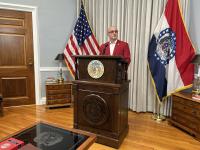
Alongside redistricting, the most concrete “governance” developments in the last 12 hours involve disaster-preparedness and budget implementation. Gov. Mike Kehoe announced Missouri has requested FEMA joint Preliminary Damage Assessments in 11 counties following April tornadoes, record hail, straight-line winds, severe storms, and flooding—covering both FEMA Individual Assistance (for uninsured home/business damage) and FEMA Public Assistance (for emergency response and recovery costs). Separately, Missouri’s budget process remains a live political issue: reporting on the $50.7 billion budget emphasizes a contentious education funding fight tied to assumptions about lottery revenue, with Democrats and some allies questioning whether education funds would be available as planned. The budget also includes a reappropriated $30 million earmark for a Springfield convention center, with the article noting the governor has discretion over release and that prior funding was withheld.
Missouri’s policy agenda also shows signs of tightening around gambling expansion and related enforcement. A Missouri Senate committee unanimously voted down a bill that would authorize video lottery games in gas stations and other locations, ending vendors’ hopes for the proposal “for another year.” The opposition—led by Senate President Pro Tem Cindy O’Laughlin and echoed by licensed casinos—centered on concerns about expanding gambling, particularly as state and federal authorities increase enforcement against existing unregulated gaming machines. In the same broader policy environment, other Missouri-related legal and regulatory stories appear in the mix, but the video lottery defeat is the clearest, decision-level development in the most recent window.
Finally, several non-redistricting items add continuity to the state’s broader political and civic landscape, though they are more routine than headline-defining. These include local government planning updates (such as Monett’s unveiling of a new comprehensive plan), a Missouri S&T student elected to the Rolla City Council, and a labor/industry development where Olin/Winchester employees ratified a revised contract to end a strike. Taken together, the last 12 hours show Missouri politics moving decisively on congressional maps and disaster/budget mechanics, while other stories largely reflect ongoing local governance and economic activity rather than a single major new political turning point.
Note: AI-generated summary based on news headlines, with neutral sources weighted more heavily to reduce bias.